How AI can help feed a growing world
Professor Jennifer Clarke shares how evolving tech can support healthier crops
By Kristen Mitchell
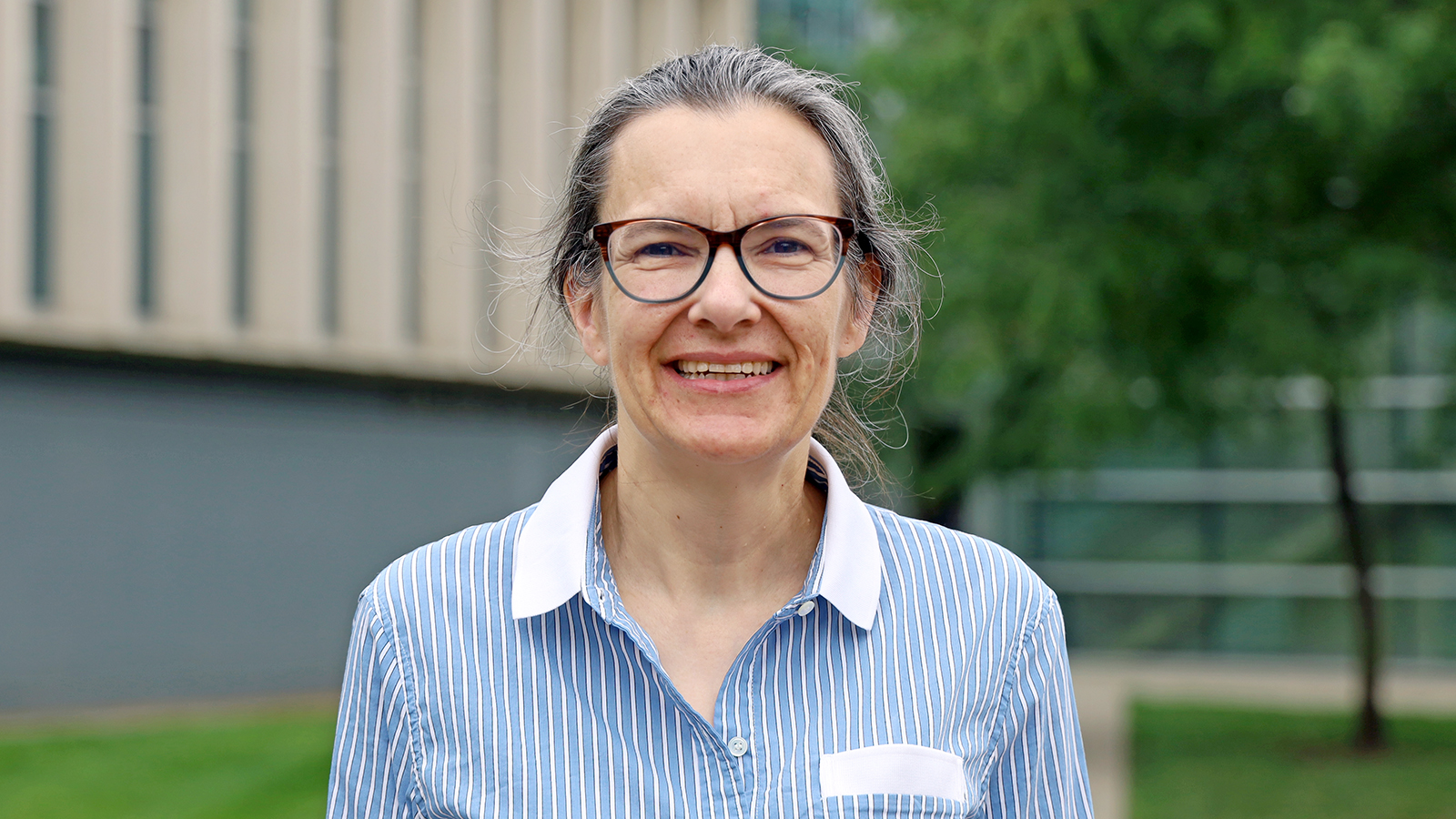
College of Public Health Professor Jennifer Clarke is focused on ensuring future generations have access to safe and nutritious food. Through statistics, imaging and artificial intelligence (AI), Clarke explores how we can create more resilient food systems and sound the alarm early when challenges arise.
Clarke came to the College of Public Health’s Division of Biostatistics as part of the university’s AI Faculty Hiring Initiative, a plan to expand AI research and education across disciplines.
She shares the public health challenges that guide her research and why she embraces AI as a tool for improving health.
Question:
What sparked your interest in food security?
I became interested in food security through plant phenotyping — measuring and analyzing a plant’s physical, chemical and biological traits. In 2013, I started working with the late Brian Larkins, a member of the National Academies and an expert in protein biochemistry in maize/corn. We discussed the shift in the plant sciences from manual measurement of traits, (such as height, leaf angle, yield, etc.) to automated measurement using sensors.
When I asked about the reasoning behind this shift, he explained the need to increase nutritious food production to meet expected demand from population growth. Addressing this challenge became a primary driver of my research.
Question:
Are there any big questions that guide your research?
The big question is whether statistics and AI can solve data problems relevant to agriculture. As in medical applications, there is a lot of data available, yet we struggle to extract the information we need. There are many reasons for this: the complexities of genetics, environment and human factors. There is also the difficulty of measuring the things that we need to measure, the fragmentation of data across locations, owners and formats, and the need for analytical methods and AI.
Question:
How do you think AI can be used to improve food security?
I can think of several ways across the food chain. One is improved early warning systems for drought, extreme heat and other climactic conditions that threaten food production. Another is improving our understanding of how genetics and environment lead to desirable crop traits, so we can develop plant varieties that will thrive in future climates. Finally, AI can improve supply chain management and tracing to improve and maintain trust in food systems.
Question:
Some people are hesitant to embrace AI in public health. How do you approach conversations about using AI to improve health and well-being?
I understand their concerns as the public discourse around AI is often confusing if not threatening. AI is like any other tool: it can be very helpful if we use it wisely.
I like to emphasize the ways that AI can improve public health. For example, we know that rural populations are medically underserved largely due to barriers to access. AI can help improve access through digital health tools such as wearable devices. I also think AI can improve awareness and communication around issues of health and well-being, and that is half the battle.
Question:
How are you hoping to deepen or expand your research at Ohio State?
I am hoping to connect with scientists interested in plant phenotyping to address questions of relevance to Ohio. I want to develop strong links with the AI so I can bring AI models and methods interesting challenges in the life sciences. I also hope to develop new international research collaborations that are strategic for Ohio State.
Question:
What is your advice for students?
Faculty are here to support you in achieving your educational goals. So be nice to yourself and ask for help when you need it.