Public Health Buckeyes: Wafa Ahmed
Fulbright student uses analysis to improve community health
By Kristen Mitchell
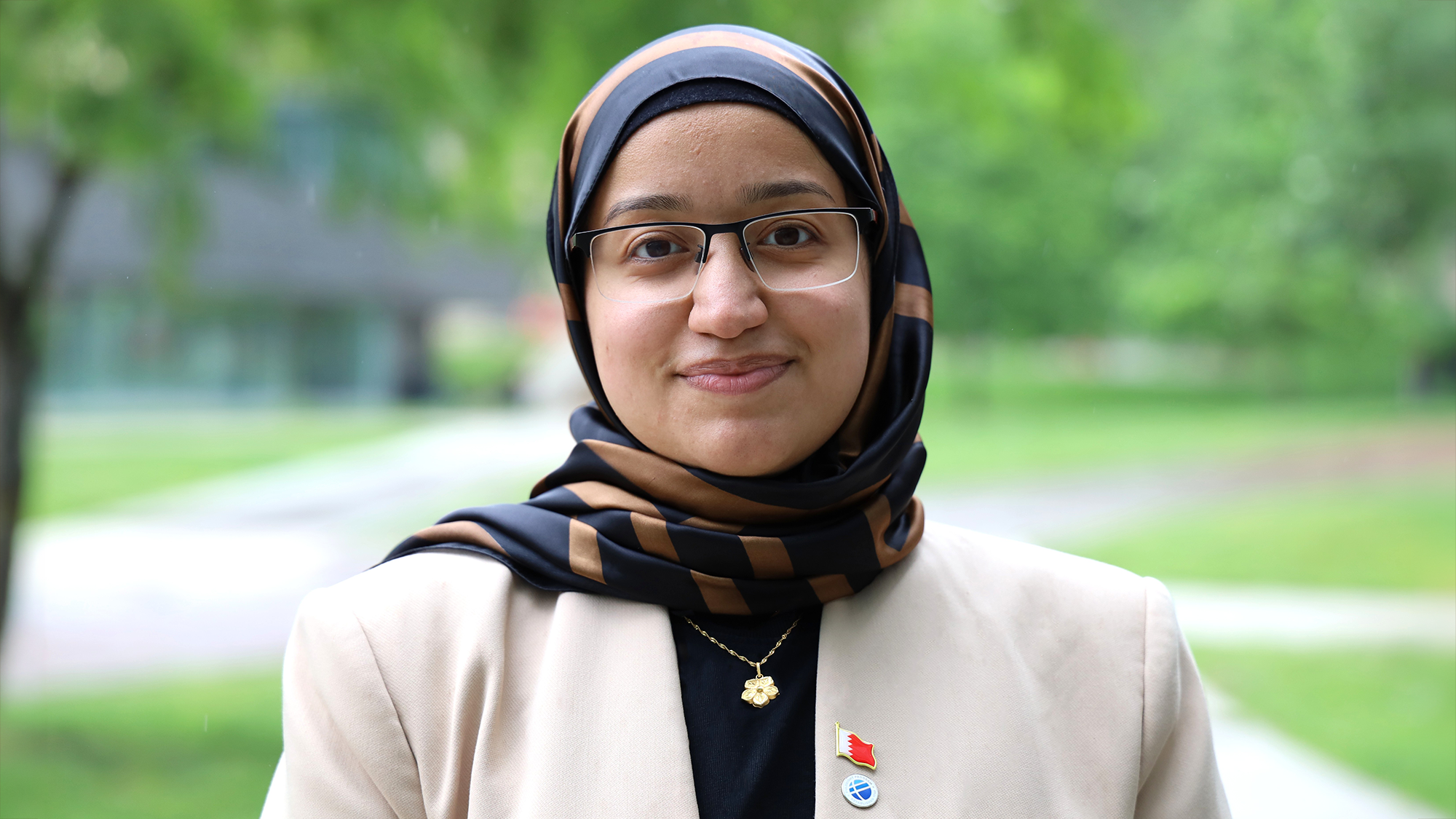
Wafa Ahmed’s public health work in Bahrain is grounded in numbers and analysis. As part of the Fulbright Foreign Student Program, she is looking to build on her passion for modeling and prediction to make a positive difference in community health.
Ahmed, who is pursuing a Master of Science in Biostatistics, shares what she enjoys most about being a College of Public Health student and what she’s looking forward to this academic year.
Question:
What inspired your interest in public health?
Honestly, I never imagined I would end up working in health — if someone had told me that 10 years ago, I would not have believed it! After finishing my bachelor's degree in statistics, the COVID-19 pandemic hit, and I was looking for an opportunity to do meaningful research. I volunteered with the Public Health Directorate at the Ministry of Health in my home country, Bahrain, and that experience changed everything. I joined the data and contact tracing team in the communicable diseases section, and I quickly witnessed just how critical statisticians are in that space. The daily work showed me how much our role truly matters.
Question:
What public health topics are you most passionate about?
I am most passionate about modeling and prediction — specifically, how these tools can help us prepare for and respond to public health situations. My work has been closely tied to decision making that directly affects community health, and that connection between analysis and real-world impact is what drives me.
Question:
How did your work as a statistician monitoring health in Bahrain motivate you to apply for the Fulbright Foreign Student Program?
So much of our work was grounded in numbers and analysis, and I became passionate about learning how to take that further, to do more advanced, impactful work. A colleague of mine was a Fulbright alumna, and she encouraged me to apply. That push, combined with my own drive to grow, is what set me on this path.
Question:
What do you enjoy most about being an Ohio State student?
The diversity of the student body stands out to me, along with the faculty. Every professor I have encountered has been genuinely willing and happy to help, and that openness makes a real difference.
Question:
Is there anything you are specifically looking forward to about your second year at CPH?
I am looking forward to deepening my skills in advanced analysis and exploring how I can connect that work to my thesis topic. I want to come out of this year with a clearer, more refined research direction.
Question:
What are your goals for the future?
I want to inspire students with my passion for statistics and support them in doing meaningful research. I also hope to bring back what I have learned and contribute to improving the work at the Ministry of Health in Bahrain.
Question:
What advice would you give to prospective CPH graduate students?
I think specializing in public health becomes even more exciting once you have seen the field in action. If you can volunteer or attend a workshop at a local health department or ministry, do it — you will quickly understand the real impact of this work.
About The Ohio State University College of Public Health
The Ohio State University College of Public Health is a leader in educating students, creating new knowledge through research, and improving the livelihoods and well-being of people in Ohio and beyond. The College's divisions include biostatistics, environmental health sciences, epidemiology, health behavior and health promotion, and health services management and policy. It is ranked first in Ohio, and 26th among all colleges and programs of public health in the nation by U.S. News and World Report. Its specialty programs are also considered among the best in the country. The MHA program is ranked 5th, the epidemiology specialty is ranked 21st, the health policy and management specialty is ranked 22nd and the biostatistics specialty is ranked 23rd.